Nguyen T.T. Nguyen
Computer Graphics · 3D Vision · Digital Humans for Robotics

Postdoctoral Researcher
Advanced Intelligent Space Lab
Ritsumeikan University · Osaka, JP
I build photorealistic, animatable digital humans and put them where people can interact with them: on screens, on holographic displays, and on a patient-simulator robot used to train medical and elderly-care staff.
I’m a postdoctoral researcher at the Advanced Intelligent Space Lab, Ritsumeikan University, where I also completed my Ph.D. (2026) as a MEXT scholar. My current work is multi-view 3D Gaussian Splatting: a pipeline that goes from pose-free sparse-view capture to real-time rendering of 4D head avatars. Earlier, I worked on generative facial behavior, teaching avatars how to listen, react, and express pain.
Before research, I spent two years as a backend/AI engineer at VNG Corporation, building ad systems that served millions of requests per second. That background still shapes how I work: I validate methods early on real, noisy data, and I care about whether a model fits the hardware and latency budget it will actually run on.
IROS '25 · REACT '24
screen · hologram · robot
collaborations in Japan
research at a glance
One pipeline, from capturing a real face to giving it a body.
- 01 · capture
Pose-free sparse-view 4D capture
Calibration-free multi-view reconstruction of animatable 3DGS head avatars. Coarse feed-forward poses are refined with pycolmap and supervise a deformable cross-view point-map network.
- 02 · track
Temporally stable 3DMM tracking
Monocular and multi-view stereo face trackers with learnable camera parameters. They turn in-the-wild video into 3DMM animation datasets with low latency.
- 03 · behave
Generative facial behavior
Avatars that listen and react to speech and vision. Methods include sparse keyframe motion tokens, FSQ facial tokenizers, and diffusion models that express pain.
- 04 · embody
Real-time rendering & embodiment
Custom CUDA kernels speed up 3DGS rendering on a consumer GPU. Avatars stream to Looking Glass holographic displays and drive a robotic shoulder-arm for range-of-motion training in VR.
news
| Oct 2026 | Started as a Postdoctoral Researcher at Ritsumeikan University, continuing work on 3DGS digital humans for care training. |
|---|---|
| Sep 2026 | Completed my Ph.D. in Information Science and Engineering at Ritsumeikan University. |
| Oct 2025 | PainDiffusion received the Best Entertainment and Amusement Paper Award at IEEE/RSJ IROS 2025. |
| May 2024 | Our team won the REACT 2024 Challenge at IEEE FG 2024 with an FSQ-based facial tokenizer for dyadic reaction generation. |
| Jan 2024 | Presented our latency-aware 3DMM face-tracking work at IEEE/SICE SII 2024. |
selected publications
- URPose-Free Sparse View 4D Face Capture with 3D Gaussian SplattingIn 2026 23rd International Conference on Ubiquitous Robots (UR), 2026
- ISRA Survey on Generative Non-verbal Facial Behavior for Highly Realistic Embodied AgentsIntelligent Service Robotics, 2026
- TCSS
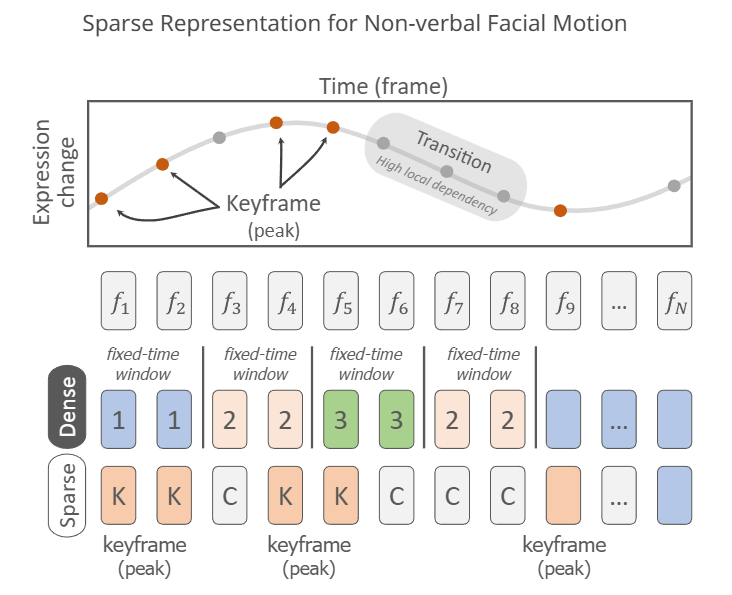 When Less is More: A Sparse Facial Motion Structure for Listening Motion LearningIEEE Transactions on Computational Social Systems, 2025
- IROSPainDiffusion: Learning to Express PainIn 2025 IEEE/RSJ International Conference on Intelligent Robots and Systems (IROS), 2025